Saturday, October 19, 2013

Letting Go


Last weekend we celebrated one of the boys’ birthday here at home. Most of the boys don’t know when their real birthdays are because they ran to the streets when they were between 5 and 10 years old and have no documentation. The boys choose their birthdays and we celebrate with soda, sweet bread, and watermelon and/or bananas.

David’s party was last Saturday night. As soon as we finished eating dinner seated around the main room of our house, the boys started dancing and spraying their soda in the air. In my head, I was thinking of the possible lecture (--you’re wasting soda which we only ever have as a special treat, thus we won’t buy it again--). 

Once the floor was slick with soda, one of the boys filled a basin with water and proceeded to throw it into the room, showering many of us. (At this point I’m thinking of all of the possible reasons to scold them… “We are renting this house and need to take care of it and not flood it”…. “What will the 2 guests think who are here? What image of us are we leaving with them?” etc…)

The basin of water was the first of many and we spent an hour dodging water basins both inside and outside the house. When things finally settled down, we got the boys together to affirm David and cut the cake. This session ended in a giant wrestling match on the slick floor, several additional water basins being thrown, and a minor knife wound because we didn’t get it out of their fast enough after the cutting of the cake.

As I witnessed this party, marveling at the boys’ childish spirits despite the many years that hardened them on the street, I had to work to silence my critical voice. I realized that for the past three years, I have worked with many youth groups in different capacities and have been rather results driven, since funders demand results, transformation, and incredible turnarounds in unrealistic timetables. I have been hyper sensitive to what others will think as a result of being the butt of constant criticism (ie: Those kids are in the youth group and they’re the same kids doing x, y, and z…. They just go to that group to shout and waste their time, etc. etc.). This dynamic has led me to be on the defensive and to push “orderliness” and good manners on occasions where I really should just let go.

This life is really too short to spend it scolding those who don’t fit into the mold of a civilized birthday party.  If we spent more time throwing water on each other and having unrestricted fun, this world of norms, results, and rules would probably be a much better place.

While I was getting ready for bed and shaking from the cold, two of the boys knocked on my door to bring me tea. I asked one of them if he had enjoyed the party, and he responded: “Yes, Auntie, I have enjoyed so so so so so so much.”  At the end of the day, that’s really all that matters.

I admire Amanda for her grace in both guiding these boys and giving them the freedom to let go. If this were another home of strict rules and punishment by canings (which is the norm in homes and schools alike here), all of these boys would have run back to their lives on the streets long ago.

Many hands cutting the cake.
Just before the cutting of the cakes.


Friday, October 4, 2013

Being a Bridge

One of my favorite things to be in this world is a bridge. I love connecting great people, gently shoving people in certain directions and watching them grow, sending people to study abroad in El Salvador knowing they won’t come back the same, etc…

Four years ago I was teaching a high school class in South Bend about my study-abroad experience in El Salvador. During the students’ 5 minute passing period, I mentioned to the homeroom teacher that I had spent time in Uganda. She expressed interest in the country and in the work I’d done and I connected her via email to those I had worked with here.

Shortly there after, she decided to say “yes” to this random invitation. She quit teaching and moved to Uganda for a month-long volunteer stint. She ended up staying indefinitely, and has since started a home for 23 boys who had lived for up to 10 years on Kampala’s streets before entering the home.

I can take no credit for the amazing work Amanda is doing in Uganda, but I do think that her “yes” is certainly a testament to what we are capable of doing with our lives when we respond wholeheartedly to life’s invitations and do not let fear/rationality/self-doubt hold us back. Four years after our meeting, I am lucky enough to be living for the year in Amanda’s home with the boys that have stolen her heart.

Reunions

On Tuesday of this week I as finally able to go back to Ssenge boys’ home where I lived four years ago.  Seeing the boys I love so much 4 years later, 4 years taller, 4 years more mature, handsome, charming…. was such a blessing. I wanted to cry as I found each one in his classroom at school (I went to their school to find them as they were in classes when I arrived). I had such a joyful reunion with them and with the home staff and they were all amazed that I can still speak Luganda (conversationally, that is… I couldn’t translate to save my life).

I am so grateful that the mysterious workings of invitations and hearts willing to listen and say yes have ensured that these boys have been well cared for these past four years, and primero Dios this will continue to be the case in the years to come. I will be spending one night a week at their home to continue to be a presence in their lives while I’m back in Uganda.

Ronal was the baby of the home when I left... he is so old and mature now and his English is great!
Shafik, who is almost taller than me now! At Ssenge boys' home.


I have also found some of the same boys still living on the streets whom I left four years ago, having treated many of their gaping wounds and having spent many days and nights in the slums with them. These reunions have broken my heart and have left me feeling impotent and angry at the unfairness of this life. I found one, Joseph, a few weeks back, and he is now taller than me, but his big brown (usually high) eyes and tattered clothes haven’t changed a bit. He saw me and nearly tackled me with a huge hug as he yelled “Nakyanzi!!!” (my Ugandan name). While I have been living, loving, growing and changing these past four years, he has been in the same slum, sniffing the same drugs, being brutally beaten by the same slum residents and City Council (local police) members…. He hugged me with such hopefulness in his eyes and surely thought I would be in the slums everyday like I was before…. but I won’t be this time.

Home Life

I am only here for 9 months, and I am staying at Amanda’s home for 23 boys between the ages of 14 and 19. They are now off the streets and back in school and overcoming addiction, etc. and have made amazing turnarounds.  I am trying to invest most of my time at this home so as to plant roots in one place and have a sustained presence (at least for 9 months) rather than being scattered about. This means that I won’t be in the slums like I was before and that I have no answers for the kids I know and love there. Our home is full and Amanda works miracles to find enough money to keep it going each month as is. She is taking some initial steps towards starting income-generating projects here (we will soon have 100 chickens at home, for instance) but self-sustainability is a long, long way off.

Meanwhile, questions of aid and sustainability aside, I stand in awe each day of these boys that (thanks to the sacrifices and funds of many families in the US, thanks to their own determination, and thanks to the love and conviction of Amanda) are making incredible strides towards turning their lives around. It is really amazing to watch them each day and to know bits and pieces of the harrowing stories that led them to the streets in the first place.


Jimmy, Richard, and Joseph sliding on the front porch during a rainstorm.


Each day the boys wake up and go to school (most of them are in fourth grade, and they continue to study though they are twice the size of most kids in their grade). The 5 boys that stay home are waiting to start breeding and selling chickens to raise money for themselves to get internships at garages to learn to become mechanics. While they wait for this project to get off the ground, Amanda and I homeschool them in reading, writing, and basic math. I’ve learned that I am a big fan of delegation and of others doing the heavy lifting (ie Amanda starting the home after I merely mentioned the country of Uganda to her), so it is a good chance for me to have to do the slow work of teaching these boys to read, when there is no one to delegate this task to. It is teaching me to foster a patience I did not know that I possessed, as I go over the same letters each day with the boys and delight in small victories, such as the long-awaited legibility of the lower case “f” after two weeks of it looking like an “s”. I hope this patience can stick with me for the long haul and spill over into many aspects of my life, and I can’t wait to watch these boys read (hopefully!) in the near future.


English class with the boys who are more advanced at reading/writing.


When the boys get home from school at around 4 a group of us heads to the netball court (a sport played mostly by women in Uganda that is like basketball, but you can’t move with the ball). I happened upon the court one day while out with the boys looking for chicken vendors and the women told me to come play. Since then I’ve been going regularly and several of the boys have started playing as well (breaking down their gender stereotypes slowly but surely!).

Playing netball with some of the boys from the home.
It is great to have found a space to share with Ugandan woman and watch them have fun and enjoy this life that otherwise seems so filled with arduous labor and second-class citizenship in a very sexist national landscape. This dynamic of sexism and male power exertion was demonstrated quite clearly the other day when the 35+ year old security guard at the netball court kicked us all out and refused to let us continue playing because the 15 year old girl he was hitting on at the court pulled her arm away from his grasp and told him not to touch her. His response to being “shamed” by her in public was to exert his power over all of us and kick us off of the court… And so it goes….

Netball court at a nearby school.


Each night Amanda, Uncle Steven (the amazingly patient Ugandan house uncle who runs the show here) and I run workshops and “devotions” with the boys. I am doing art-therapy type workshops, similar to those that I did in prison in El Salvador. This has been a fruitful space for discussion and self-expression thus far, though we are all pretty tired by this point of the day and some days we’d all just rather sleep!

More to come… thanks for reading!


Friday, September 27, 2013

P.S.

Here's the website for the group I'm w/ currently... more in the next post on their mission and on my role here!

lot2545.org

Boys at home with Amanda, the home's founder, at one of the boys' birthday parties.
(I arrived several hours later from the US at 3am!)

Back to Uganda


Before I graduated from college I decided that I wanted to live in El Salvador for a few years and then spend time in Uganda again. Three years later, I am sticking to this plan, as I promised many people in Uganda that I would, indeed, come back.

In my 3-year stay in El Salvador, I could very clearly see the ways in which I continued to learn a great deal each year both linguistically and experientially about the complexities and nuances of Salvadoran culture, history, and current socio-political context. Looking back, it is clear that after one year (and even after 3) I barely scratched the surface and have much more to learn.

Given this realization, I began to doubt my decision to come back to Uganda for 9 months before (hopefully) going to grad school in Peace Studies next fall. Was it worth it to just barely scratch the surface again, given that my presence here would not be a sustainable one? Was it selfish to invest myself here in the lives of 20 boys who have lived for many years on the streets, knowing that I would soon pack up again and leave? Was I wasting money on my plane ticket that could have otherwise been spent on any number of sustainable peacebuilding projects?

 As I got off of the plane in Uganda at 3am, these questions still had no answers. However, when I reached the boys home where I will be staying (more on the home in my next post!), several of the boys woke up at 4am to welcome me. One of these boys was Joseph, a boy I had known 4 years ago in the slums when he was still living on the streets. His face lit up when he saw me, and he gave me a big hug. I began asking him how all of the other boys are that I knew. Most of them are still on the streets, others he lost track of, and still others have died.


Just as I was going to go to bed, he took my hand and said “Webale kuddayo, Auntie Nakyanzi” (Thank you for coming back Auntie Nakyanzi -that’s my Ugandan name-). There are many people in need of accompaniment in this world and I will certainly continue to wrestle with questions of sustainability/best investment of myself given the complexities of race/nationality/privilege. However, in that moment, Joseph’s thank you was all the affirmation I needed that right now, I am right where I need to be. 

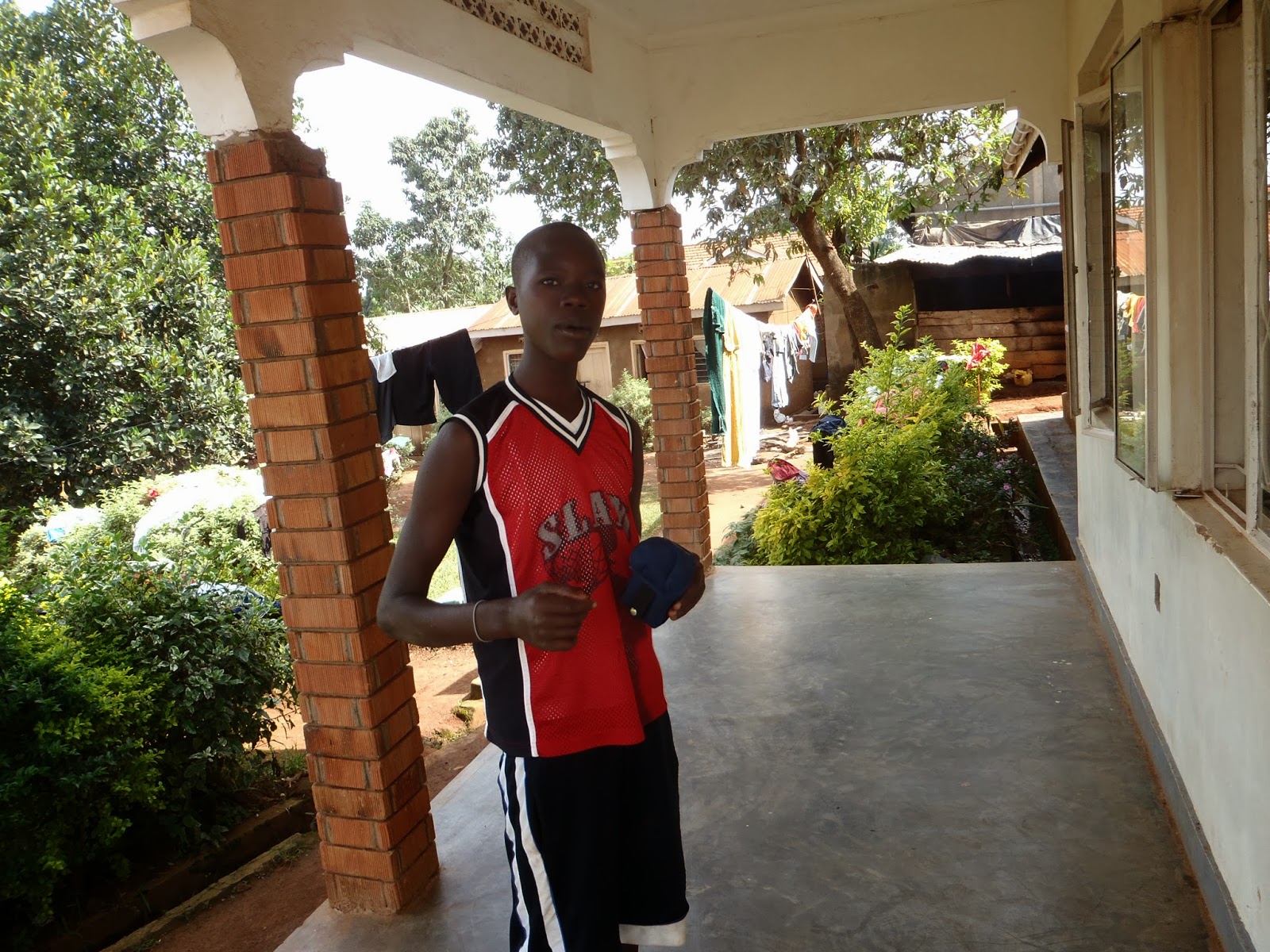
Joseph at home on our front porch.

A Glance Back Before Moving Forward...


Greetings from Uganda!

 I’m realizing that it’s been nearly a year since I wrote on this blog—yikes! That is quite unfortunate given the fact that there were countless stories to share in my final 8 months in El Salvador. I got caught up working on the publication of two books of poetry/artwork by the incarcerated youth I was working with, and didn’t keep up on the blogging end of things. In any event, I will try to be better about it this year in Uganda, as it is entirely selfish and a disservice so many who share their stories and lives with me to keep them all to myself.

Before delving into my first few weeks here in Uganda, I want to share a reflection I wrote for CRISPAZ, the organization that supported me as a long-term volunteer in El Salvador for the past 3 years. While I generally failed at writing regularly, this gives a bit of an inadequate summary of some of the lessons I learned in my time there. Read ahead if you wish!


CRISPAZ (Christians for Peace in El Salvador) Long-Term Volunteer Reflection

I hesitate to begin to write this article, because there is simply no way I can adequately sum up three years of insights, heartbreak, relationships, and stories from my time in El Salvador. I will give it a shot, however, with the hope that in a later update I can post the link to the books of poetry by imprisoned youth that I am currently working to translate. The books will provide a much more complete picture of the lives of the youth I’ve spent the past three years accompanying.

Jovenes Constructores

Having spent time in El Salvador as a high school and college student, I knew that I would want to end up there after graduation. With a Fulbright scholarship and a subsequent Crispaz long-term volunteer position, I began a three-year part-time internship with Fundación Quetzalcoatl: Ideas y Acciones para la Paz, an associate of Catholic Relief Services (CRS).

Throughout the majority of the internship I worked alongside program facilitators leading youth groups in communities controlled by gangs and facilitating life skills/violence prevention workshops through the Jóvenes Constructores (Youth Build) program. This program began in the United States in 1978 and has since spread to 20 countries world-over. The program focuses on training vulnerable youth to become leaders in their communities through life skills and vocational skills training.  At Quetzalcoatl I, too, received training in various educational pedagogies that we utilized in our workshops including movement-based education, popular education, constructivism, and solutions-based systemic education. I also received training in HATCH Teaching Methods for Opportunity Youth through Mockingbird Education, which focuses on the importance of understanding cognition and memory in order to design effective teaching methods.

 In three years time I was able to accompany over 300 youth through their six-month learning experiences. I learned an incredible amount about the challenges that youth face in El Salvador because of the layers of structural violence at play, which limit their opportunities long before they are born.  I witnessed the many ways in which the capitalist system and US influence in El Salvador continue to exacerbate poverty and violence in a multitude of both visible and invisible ways. Additionally, I learned a great deal about the workings of non-profits that depend on international donor agencies for funding.

Our organization, Fundación Quetzalcoatl, was funded by Catholic Relief Services, and the relationship was rocky, to say the very least, between CRS and our under-staffed and over-worked team of inspiring individuals who were hired to carry out the Jovenes Constructores project.  Throughout my time with Quetzalcoatl, I gained first hand insight into the unrealistic demands of donor agencies, whose standards often come from different countries and contexts and have not been appropriately adjusted to the Salvadoran reality. I also witnessed a great deal of the corruption that results when donor funds reach the hands of the desperately impoverished as well the self-righteous and greedy.

Proyecto Cuentame

While with Quetzalcoatl, I became acutely aware of the lack of opportunities for incarcerated, and formally incarcerated youth. USAID restrictions on donor funds prohibits that formally incarcerated youth participate in our violence prevention/vocational skills training programs. This policy is counter-intuitive, to say the least, but goes to show the ways in which youth caught up in the justice system have even fewer chances for success in a country that marginalizes and fears them (as do its “peacebuilding” donors).

Having glimpsed the ways in which incarcerated youth are stereotyped, misunderstood, and generally abandoned, I decided to co-found Proyecto Cuentame, a creative writing initiative based on self-exploration, critical thinking, and humanization of the incarcerated population. I co-founded the initiative with fellow Crispaz volunteer, Maria Hoisington.

In essence, through Proyecto Cuentame, I spent two and a half years in two juvenile detention centers practicing empathetic listening and creating space in my heart for over 100 young people’s stories and confessions, long silenced by fear and rejection. Through this process of accompaniment and documentation, I learned more about the complexity of gang culture, violent trauma, and redemptive love than I had ever imagined.  I co-published two volumes of the incarcerated young men and women’s writings and artwork, which have been made available to youth, schoolteachers, government officials, NGOs, and judges alike. They serve as tools for violence prevention and relay a cry for a deeper understanding of the “delinquent” youth whom the current justice system dehumanizes and re-victimizes. They are the building blocks for the restorative justice program I hope to start one day.

As I stayed in touch with youth who had been released from prisons, I merely waited for all too familiar patterns as their fear-filled, liminal existence so often ended in either their violent deaths or their abrupt, unfounded arrests. It is ultimately for these youth that I plan to pursue a Master’s degree in Peace Studies with a focus on conflict analysis and transformation in order to expand my knowledge of this field. After all, in countries like El Salvador, characterized by decades of polarization and accumulated social trauma, unless there is a dramatic shift towards restoration of right relationship, youth’s lives will continue to be defined by violent crime and tragic deaths long after “peace treaties” have been signed.


Colonia Dolores Medina

            Throughout my three years in El Salvador, my lifeline was undoubtedly the community, Dolores Medina, in which I lived and shared every night after long, exhausting days. I lived with two remarkable women and their three children and became close to every one of the 40 families that make up the former refugee community. As a member of this community, I was exposed to the reality of abject poverty, when dollars simply don’t add up to put food on the table. I bore witness to the machismo that plays out inter-generationally, the failure of the healthcare system to attend to sick children and adults, the violent deaths of ostracized youth… the list goes on and on. I also experienced the daily joys of still being alive... of playing soccer with a women’s team, attending prayer services with relentlessly faithful women, putting on community celebrations with our youth group for Mother’s Day, Christmas….. this list, too, goes on and on.

            Just as I was preparing to leave El Salvador, grace worked in such a way that I was able to start a college scholarship program for youth in Dolores Medina, thanks to generous donors of both money and time in the US and El Salvador. This program, Nueva Esperanza will begin in January, 2014 with its first 4 students, who will be pursuing technical degrees in various fields.  The program couples supporting youth in one’s home community with the pursuit of higher education. Ideally it will be a pilot program that expands to include more aspiring students, since opportunities for higher education in El Salvador are scarce, to say the least.


            I thank all who support Crispaz for making it possible for me to spend the past three years learning a great deal and sharing in the lives many Salvadorans.  I can assure you that my volunteer experience was not in vain, as my life of accompaniment and work in the field of peacebuilding is just beginning.

Youth from Calle Real on a camping trip excursion in 2011.