Friday, October 4, 2013

Being a Bridge

One of my favorite things to be in this world is a bridge. I love connecting great people, gently shoving people in certain directions and watching them grow, sending people to study abroad in El Salvador knowing they won’t come back the same, etc…

Four years ago I was teaching a high school class in South Bend about my study-abroad experience in El Salvador. During the students’ 5 minute passing period, I mentioned to the homeroom teacher that I had spent time in Uganda. She expressed interest in the country and in the work I’d done and I connected her via email to those I had worked with here.

Shortly there after, she decided to say “yes” to this random invitation. She quit teaching and moved to Uganda for a month-long volunteer stint. She ended up staying indefinitely, and has since started a home for 23 boys who had lived for up to 10 years on Kampala’s streets before entering the home.

I can take no credit for the amazing work Amanda is doing in Uganda, but I do think that her “yes” is certainly a testament to what we are capable of doing with our lives when we respond wholeheartedly to life’s invitations and do not let fear/rationality/self-doubt hold us back. Four years after our meeting, I am lucky enough to be living for the year in Amanda’s home with the boys that have stolen her heart.

Reunions

On Tuesday of this week I as finally able to go back to Ssenge boys’ home where I lived four years ago.  Seeing the boys I love so much 4 years later, 4 years taller, 4 years more mature, handsome, charming…. was such a blessing. I wanted to cry as I found each one in his classroom at school (I went to their school to find them as they were in classes when I arrived). I had such a joyful reunion with them and with the home staff and they were all amazed that I can still speak Luganda (conversationally, that is… I couldn’t translate to save my life).

I am so grateful that the mysterious workings of invitations and hearts willing to listen and say yes have ensured that these boys have been well cared for these past four years, and primero Dios this will continue to be the case in the years to come. I will be spending one night a week at their home to continue to be a presence in their lives while I’m back in Uganda.

Ronal was the baby of the home when I left... he is so old and mature now and his English is great!
Shafik, who is almost taller than me now! At Ssenge boys' home.


I have also found some of the same boys still living on the streets whom I left four years ago, having treated many of their gaping wounds and having spent many days and nights in the slums with them. These reunions have broken my heart and have left me feeling impotent and angry at the unfairness of this life. I found one, Joseph, a few weeks back, and he is now taller than me, but his big brown (usually high) eyes and tattered clothes haven’t changed a bit. He saw me and nearly tackled me with a huge hug as he yelled “Nakyanzi!!!” (my Ugandan name). While I have been living, loving, growing and changing these past four years, he has been in the same slum, sniffing the same drugs, being brutally beaten by the same slum residents and City Council (local police) members…. He hugged me with such hopefulness in his eyes and surely thought I would be in the slums everyday like I was before…. but I won’t be this time.

Home Life

I am only here for 9 months, and I am staying at Amanda’s home for 23 boys between the ages of 14 and 19. They are now off the streets and back in school and overcoming addiction, etc. and have made amazing turnarounds.  I am trying to invest most of my time at this home so as to plant roots in one place and have a sustained presence (at least for 9 months) rather than being scattered about. This means that I won’t be in the slums like I was before and that I have no answers for the kids I know and love there. Our home is full and Amanda works miracles to find enough money to keep it going each month as is. She is taking some initial steps towards starting income-generating projects here (we will soon have 100 chickens at home, for instance) but self-sustainability is a long, long way off.

Meanwhile, questions of aid and sustainability aside, I stand in awe each day of these boys that (thanks to the sacrifices and funds of many families in the US, thanks to their own determination, and thanks to the love and conviction of Amanda) are making incredible strides towards turning their lives around. It is really amazing to watch them each day and to know bits and pieces of the harrowing stories that led them to the streets in the first place.


Jimmy, Richard, and Joseph sliding on the front porch during a rainstorm.


Each day the boys wake up and go to school (most of them are in fourth grade, and they continue to study though they are twice the size of most kids in their grade). The 5 boys that stay home are waiting to start breeding and selling chickens to raise money for themselves to get internships at garages to learn to become mechanics. While they wait for this project to get off the ground, Amanda and I homeschool them in reading, writing, and basic math. I’ve learned that I am a big fan of delegation and of others doing the heavy lifting (ie Amanda starting the home after I merely mentioned the country of Uganda to her), so it is a good chance for me to have to do the slow work of teaching these boys to read, when there is no one to delegate this task to. It is teaching me to foster a patience I did not know that I possessed, as I go over the same letters each day with the boys and delight in small victories, such as the long-awaited legibility of the lower case “f” after two weeks of it looking like an “s”. I hope this patience can stick with me for the long haul and spill over into many aspects of my life, and I can’t wait to watch these boys read (hopefully!) in the near future.


English class with the boys who are more advanced at reading/writing.


When the boys get home from school at around 4 a group of us heads to the netball court (a sport played mostly by women in Uganda that is like basketball, but you can’t move with the ball). I happened upon the court one day while out with the boys looking for chicken vendors and the women told me to come play. Since then I’ve been going regularly and several of the boys have started playing as well (breaking down their gender stereotypes slowly but surely!).

Playing netball with some of the boys from the home.
It is great to have found a space to share with Ugandan woman and watch them have fun and enjoy this life that otherwise seems so filled with arduous labor and second-class citizenship in a very sexist national landscape. This dynamic of sexism and male power exertion was demonstrated quite clearly the other day when the 35+ year old security guard at the netball court kicked us all out and refused to let us continue playing because the 15 year old girl he was hitting on at the court pulled her arm away from his grasp and told him not to touch her. His response to being “shamed” by her in public was to exert his power over all of us and kick us off of the court… And so it goes….

Netball court at a nearby school.


Each night Amanda, Uncle Steven (the amazingly patient Ugandan house uncle who runs the show here) and I run workshops and “devotions” with the boys. I am doing art-therapy type workshops, similar to those that I did in prison in El Salvador. This has been a fruitful space for discussion and self-expression thus far, though we are all pretty tired by this point of the day and some days we’d all just rather sleep!

More to come… thanks for reading!


Friday, September 27, 2013

P.S.

Here's the website for the group I'm w/ currently... more in the next post on their mission and on my role here!

lot2545.org

Boys at home with Amanda, the home's founder, at one of the boys' birthday parties.
(I arrived several hours later from the US at 3am!)

Back to Uganda


Before I graduated from college I decided that I wanted to live in El Salvador for a few years and then spend time in Uganda again. Three years later, I am sticking to this plan, as I promised many people in Uganda that I would, indeed, come back.

In my 3-year stay in El Salvador, I could very clearly see the ways in which I continued to learn a great deal each year both linguistically and experientially about the complexities and nuances of Salvadoran culture, history, and current socio-political context. Looking back, it is clear that after one year (and even after 3) I barely scratched the surface and have much more to learn.

Given this realization, I began to doubt my decision to come back to Uganda for 9 months before (hopefully) going to grad school in Peace Studies next fall. Was it worth it to just barely scratch the surface again, given that my presence here would not be a sustainable one? Was it selfish to invest myself here in the lives of 20 boys who have lived for many years on the streets, knowing that I would soon pack up again and leave? Was I wasting money on my plane ticket that could have otherwise been spent on any number of sustainable peacebuilding projects?

 As I got off of the plane in Uganda at 3am, these questions still had no answers. However, when I reached the boys home where I will be staying (more on the home in my next post!), several of the boys woke up at 4am to welcome me. One of these boys was Joseph, a boy I had known 4 years ago in the slums when he was still living on the streets. His face lit up when he saw me, and he gave me a big hug. I began asking him how all of the other boys are that I knew. Most of them are still on the streets, others he lost track of, and still others have died.


Just as I was going to go to bed, he took my hand and said “Webale kuddayo, Auntie Nakyanzi” (Thank you for coming back Auntie Nakyanzi -that’s my Ugandan name-). There are many people in need of accompaniment in this world and I will certainly continue to wrestle with questions of sustainability/best investment of myself given the complexities of race/nationality/privilege. However, in that moment, Joseph’s thank you was all the affirmation I needed that right now, I am right where I need to be. 

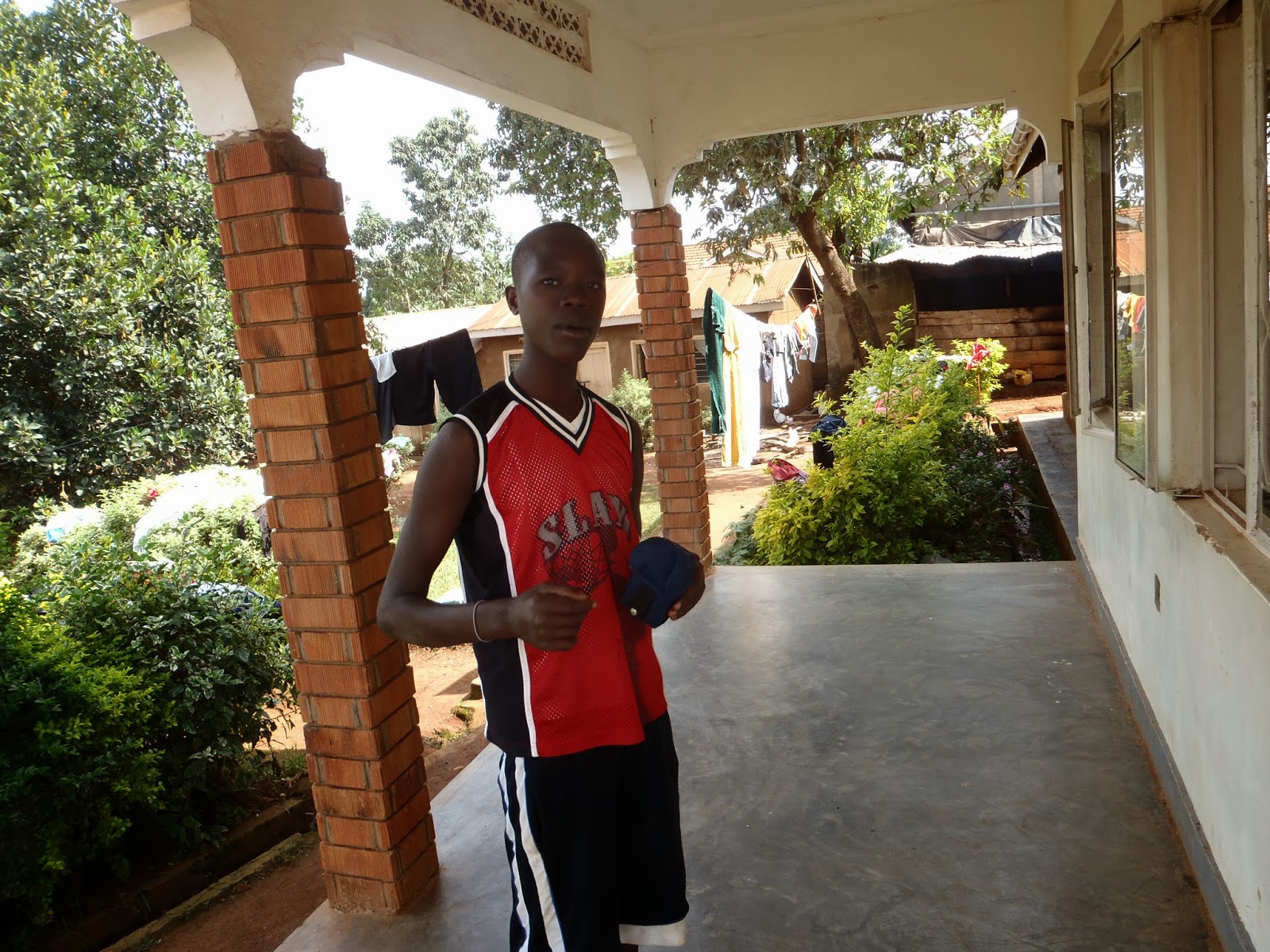
Joseph at home on our front porch.

A Glance Back Before Moving Forward...


Greetings from Uganda!

 I’m realizing that it’s been nearly a year since I wrote on this blog—yikes! That is quite unfortunate given the fact that there were countless stories to share in my final 8 months in El Salvador. I got caught up working on the publication of two books of poetry/artwork by the incarcerated youth I was working with, and didn’t keep up on the blogging end of things. In any event, I will try to be better about it this year in Uganda, as it is entirely selfish and a disservice so many who share their stories and lives with me to keep them all to myself.

Before delving into my first few weeks here in Uganda, I want to share a reflection I wrote for CRISPAZ, the organization that supported me as a long-term volunteer in El Salvador for the past 3 years. While I generally failed at writing regularly, this gives a bit of an inadequate summary of some of the lessons I learned in my time there. Read ahead if you wish!


CRISPAZ (Christians for Peace in El Salvador) Long-Term Volunteer Reflection

I hesitate to begin to write this article, because there is simply no way I can adequately sum up three years of insights, heartbreak, relationships, and stories from my time in El Salvador. I will give it a shot, however, with the hope that in a later update I can post the link to the books of poetry by imprisoned youth that I am currently working to translate. The books will provide a much more complete picture of the lives of the youth I’ve spent the past three years accompanying.

Jovenes Constructores

Having spent time in El Salvador as a high school and college student, I knew that I would want to end up there after graduation. With a Fulbright scholarship and a subsequent Crispaz long-term volunteer position, I began a three-year part-time internship with Fundación Quetzalcoatl: Ideas y Acciones para la Paz, an associate of Catholic Relief Services (CRS).

Throughout the majority of the internship I worked alongside program facilitators leading youth groups in communities controlled by gangs and facilitating life skills/violence prevention workshops through the Jóvenes Constructores (Youth Build) program. This program began in the United States in 1978 and has since spread to 20 countries world-over. The program focuses on training vulnerable youth to become leaders in their communities through life skills and vocational skills training.  At Quetzalcoatl I, too, received training in various educational pedagogies that we utilized in our workshops including movement-based education, popular education, constructivism, and solutions-based systemic education. I also received training in HATCH Teaching Methods for Opportunity Youth through Mockingbird Education, which focuses on the importance of understanding cognition and memory in order to design effective teaching methods.

 In three years time I was able to accompany over 300 youth through their six-month learning experiences. I learned an incredible amount about the challenges that youth face in El Salvador because of the layers of structural violence at play, which limit their opportunities long before they are born.  I witnessed the many ways in which the capitalist system and US influence in El Salvador continue to exacerbate poverty and violence in a multitude of both visible and invisible ways. Additionally, I learned a great deal about the workings of non-profits that depend on international donor agencies for funding.

Our organization, Fundación Quetzalcoatl, was funded by Catholic Relief Services, and the relationship was rocky, to say the very least, between CRS and our under-staffed and over-worked team of inspiring individuals who were hired to carry out the Jovenes Constructores project.  Throughout my time with Quetzalcoatl, I gained first hand insight into the unrealistic demands of donor agencies, whose standards often come from different countries and contexts and have not been appropriately adjusted to the Salvadoran reality. I also witnessed a great deal of the corruption that results when donor funds reach the hands of the desperately impoverished as well the self-righteous and greedy.

Proyecto Cuentame

While with Quetzalcoatl, I became acutely aware of the lack of opportunities for incarcerated, and formally incarcerated youth. USAID restrictions on donor funds prohibits that formally incarcerated youth participate in our violence prevention/vocational skills training programs. This policy is counter-intuitive, to say the least, but goes to show the ways in which youth caught up in the justice system have even fewer chances for success in a country that marginalizes and fears them (as do its “peacebuilding” donors).

Having glimpsed the ways in which incarcerated youth are stereotyped, misunderstood, and generally abandoned, I decided to co-found Proyecto Cuentame, a creative writing initiative based on self-exploration, critical thinking, and humanization of the incarcerated population. I co-founded the initiative with fellow Crispaz volunteer, Maria Hoisington.

In essence, through Proyecto Cuentame, I spent two and a half years in two juvenile detention centers practicing empathetic listening and creating space in my heart for over 100 young people’s stories and confessions, long silenced by fear and rejection. Through this process of accompaniment and documentation, I learned more about the complexity of gang culture, violent trauma, and redemptive love than I had ever imagined.  I co-published two volumes of the incarcerated young men and women’s writings and artwork, which have been made available to youth, schoolteachers, government officials, NGOs, and judges alike. They serve as tools for violence prevention and relay a cry for a deeper understanding of the “delinquent” youth whom the current justice system dehumanizes and re-victimizes. They are the building blocks for the restorative justice program I hope to start one day.

As I stayed in touch with youth who had been released from prisons, I merely waited for all too familiar patterns as their fear-filled, liminal existence so often ended in either their violent deaths or their abrupt, unfounded arrests. It is ultimately for these youth that I plan to pursue a Master’s degree in Peace Studies with a focus on conflict analysis and transformation in order to expand my knowledge of this field. After all, in countries like El Salvador, characterized by decades of polarization and accumulated social trauma, unless there is a dramatic shift towards restoration of right relationship, youth’s lives will continue to be defined by violent crime and tragic deaths long after “peace treaties” have been signed.


Colonia Dolores Medina

            Throughout my three years in El Salvador, my lifeline was undoubtedly the community, Dolores Medina, in which I lived and shared every night after long, exhausting days. I lived with two remarkable women and their three children and became close to every one of the 40 families that make up the former refugee community. As a member of this community, I was exposed to the reality of abject poverty, when dollars simply don’t add up to put food on the table. I bore witness to the machismo that plays out inter-generationally, the failure of the healthcare system to attend to sick children and adults, the violent deaths of ostracized youth… the list goes on and on. I also experienced the daily joys of still being alive... of playing soccer with a women’s team, attending prayer services with relentlessly faithful women, putting on community celebrations with our youth group for Mother’s Day, Christmas….. this list, too, goes on and on.

            Just as I was preparing to leave El Salvador, grace worked in such a way that I was able to start a college scholarship program for youth in Dolores Medina, thanks to generous donors of both money and time in the US and El Salvador. This program, Nueva Esperanza will begin in January, 2014 with its first 4 students, who will be pursuing technical degrees in various fields.  The program couples supporting youth in one’s home community with the pursuit of higher education. Ideally it will be a pilot program that expands to include more aspiring students, since opportunities for higher education in El Salvador are scarce, to say the least.


            I thank all who support Crispaz for making it possible for me to spend the past three years learning a great deal and sharing in the lives many Salvadorans.  I can assure you that my volunteer experience was not in vain, as my life of accompaniment and work in the field of peacebuilding is just beginning.

Youth from Calle Real on a camping trip excursion in 2011.

Monday, November 12, 2012

Rehabilitation or Dehumanization?


Hello! I hope this blog post finds you well wherever you might be.

I wanted to share an experience that happened recently to a family in my community, as it illustrates the way in which prisoners´ lives here in El Salvador (and world over I would argue) are marked by dehumanization and neglect rather than rehabilitation and transformation.   

Five of my dearest friends in my community have been waiting for 6 long years for their father (I´ll call him Hector) to be released from prison. Hector worked at a mechanic shop and was locked up for working on stolen cars. The details remain quite blurry as to whether or not he was aware that he was working on stolen cars, but since he could not afford a lawyer, he was sentenced to 7 years in prison.

Hector began his sentence in a prison designed for 2,000 inmates which is “home” to more than 8,000 men. Prisoners sleep on the floor and constantly suffer from fungal skin diseases as well as malnourishment and abuse from fellow inmates.

Legally, prisoners have to be assigned a social worker, a psychologist, and a legal advisor. However, as the number of detained persons here has skyrocketed, the number of staff working in each prison has remained the same, leaving startling ratios of staff to inmates. In Hector´s prison, there is one social worker and one psychologist assigned to 2,000 inmates. Since it is impossible to provide professional attention to so many individuals on a regular basis, the majority of inmates have never met once with any professional staff member.

Hector was given a psychological exam shortly after being imprisoned 6 years ago. The results characterize him as a violent person who neither works nor studies in order to make the most of his time in prison. This is not surprising given that imprisonment in itself produces depression and violent behavior in individuals who have been uprooted from their communities and (justly or unjustly) forced to face any number of years in places that must look just like hell, should hell exist.  

In the last 5 years of his imprisonment, Hector has dedicated his time in prison to woodshop. He constantly makes tables, mirrors, benches, and picture frames for his wife and 9 children to sell. Since his wife makes 3 dollars a day on a good day selling his wares at the market, his children have been forced to drop out of school because they can hardly afford food, much less schooling. Hector began to study for a time in prison, but he dropped out because he would frequently faint from hunger in class.

Though he has a 7 year sentence, the judge gave he and his family hope that he would be able to get out on parole after 6 years. Since last Monday was his long awaited follow up court case, his family spent all weekend cleaning their small home preparing for his arrival.

When the day finally arrived to go to court, his children and grandchildren waited anxiously to see him. He was brought into the courtroom, handcuffed and chained at his feet. The judge proceeded to tell him that his psychological report (which was taken 5 years ago) declared that he was a violent individual who neither worked nor studied and was thus not apt to reenter society. The same psychological report has been used repeatedly as grounds for his continued imprisonment, though he has never had a follow up exam. His wife yelled out through her tears that he works, and that she sells his woodwork, but the judge wouldn´t believe her since she didn´t have “proof”. No one in the prison system had thought to write on his record that he has been working in woodshop for the past 5 years. He is another number. Another offender. Another criminal unworthy of living his life. He will be released, at best, 1 year after his sentence is completed, since the justice system is so backlogged here that inmates often wait at least a year after their sentence to finally be released. This is the cherry on top of the psychological torture that is long term imprisonment.

Hector´s children, wife, and grandchildren walked up to meet him, crying after the trial and were told by the guards that they were not allowed to touch him. They couldn´t believe how skinny, grey haired, and worn he looked. Hector managed to hold back his tears and ask the names of the five grandchildren he was meeting for the first time. They asked him innocently why he was tied up by his hands and his feet and he responded that he played in the street too much (their most frequent offense as small children).

He was quickly led back to his holding cell where his wife got in line to leave food for him. The guards revise the food and eat anything they wish to eat (generally all of the meat left for inmates) before passing it along to them. When Hector´s food reached him, the guards refused to take off his handcuffs, and he was forced to eat with his mouth, kneeling on the ground as if he were a dog.

Prison, in theory, is a place for rehabilitation. It is supposed to serve to prevent recidivism. Hector receives no psychological attention and no character evaluations. He was not allowed to touch his children or grandchildren. He ate handcuffed on the ground like a dog. Rehabilitation? Transformation? Prison here (and most everywhere) serves to break the human spirit by inflicting people to a life of constant humiliation. Inmates are deemed criminals. Period. Black and white. We are the good guys, they are the bad guys. Yet these individuals were almost certainly victims far before they were perpetrators. They almost certainly were plucked out of marginalized communities that we prefer to drive through with our doors locked and our music blaring, so as not to enter their world even in our imagination, much less with open, compassionate hearts willing to invest our lives in the struggle to end this segregation and incessant incarceration.

As Hector´s family trudged back to the bus stop to head back to the home they had again cleaned with high hopes only to have them dashed, his youngest grandchild Paty tugged at his wife´s sleeve. She set her big brown inquisitive eyes on her grandma and with the heartbreaking innocence that only a 3 year old can muster she asked in a timid voice, “Grandma, did they kill grandpa yet?” Hector´s wife broke down sobbing. In the logical mind of this 3 year old, if a man with an assault weapon escorts your grandfather away from you, chained by the hands and feet, he is going to kill him.

Though Hector´s wife tearfully responded that no, they were not going to kill her grandfather, she likely wondered if Paty had discovered the secret of mass incarceration here in El Salvador. In many ways, these years of dehumanization have already killed him. They have killed his hopeful spirit, as well as those of many who love him and continue to wait for his return.

If you have a moment, volunteer in a prison near you! You will find similar stories that will surely break your heart and call into question the practice of imprisonment that many take for granted as just and necessary.  If you are interested in learning more about prison reform/abolition I recommend you read Are Prisons Obsolete? By Angela Y. Davis. 

Monday, October 29, 2012

Tuesdays


Hello!

Below I´ve posted a poem I wrote recently that attempts to describe my Tuesdays at the male youth detention center in a way that prose just can´t. Enjoy!

Tuesdays

Only their plastic kites
manage to escape
the confines of infinity
where their youthful spirits
live trapped in a mud-coated hell

Where I write their words
but not my own
listen to their hearts
but rarely my own
and bathe them in a love
that is not my own.

It comes some days
overflowing
from God
knows where
and others it is all dried up
but mostly
it is always there
at least subtly
soothing sages
who long to be heard
though it can offer
little hope,
just a gaze
that has never seen them
slice or shoot
and thus embraces
their tired eyes in a tenderness
that on a good day
transcends the surrounding filth
in moments that will stay
at least with me
until my mind
quits remembering. 

Tuesday, October 16, 2012

Orchestra Behind Bars

 
 I’ve been meaning to write for quite some time about a beautiful experiment that took place several weeks ago in the young women’s detention center where I do poetry workshops.

On July 30th there was a revolt within the Center, which nearly resulted in the violent deaths of an entire sector of girls affiliated with a certain gang. Luckily the police were able to intervene in time, but the result has been an unprecedented division between inmates. Whereas for the past 5 years the girls have studied together, gone to workshops together, and eaten together in the Center regardless of gang affiliation, they have now been divided such that they have no contact at all.

Now, slightly less than half of the population is stuck in a corner of the Center where they have no outdoor space and thus never feel the sun’s rays. The girls have expressed that they feel more incarcerated than ever before and that they cannot stand the thought of being cooped up in this tiny space for so many years.

 While the incident was certainly not one to be taken lightly, I still can’t help but see the decision to separate the girls as a huge step backwards. It seems like a cop-out of sorts, resorting to the all too familiar habit in El Salvador of creating yet another division and deeming impossible attempts at dialogue, peace-keeping circles, negotiations, and creative attempts to construct peaceful coexistence. However, since there never seem to be adequate funds, personnel, or peacebuilding training to think outside of the box, the decision has been made and seems to be irreversible.

 It is into this quite hostile context that 3 passionate, energetic orchestra instructors from Chile and Argentina (who had no idea of the pre-existing conflict and recent division) came onto the scene. They had received a donation to purchase 30 cellos, violas, and violins to teach an intensive 2-week music coarse in the Center. I was extremely skeptical of such a short-term initiative, but sure enough, 25 girls were reunited for the first time since the division as they took up an instrument for the first time in their lives and practiced rigorously without a single outbreak of conflict between them.

When the day came to bring the girls to an auditorium to perform together with the youth symphonic orchestra of El Salvador, the excitement in the Center was electric (literally). All of the girls were straightening their hair and dressing to impress for the big event, when the Center’s director came in to announce that not all of the girls would be allowed to participate in the concert. For “poor behavior” several of their judges had sent a last minute fax informing that 7 of the girls would not be allowed to perform.

As I watched tears roll down the faces of the girls who were forced to stay behind, I couldn’t help but think that this is the exact opposite of what a “rehabilitation center” should do. This would likely be the only chance these girls will get to perform on a stage in their lives, so to take this away from them at the last minute after their dedicated commitment for two weeks seemed ridiculous at best.

One of the girls who was most devastated by the news burst into sobs because she had worked so hard for two weeks in vain, and her friends had promised to go see her perform. Her prison sentence ends in November of this year, and I can’t help but think that it was simply the judge’s last chance to screw her over while she is still under his control. The punitive system is so focused on punishment while personal/emotional development, trauma therapy, and affirmations are rarely part of the picture. Given that

Disappointments aside, the concert was absolutely beautiful. I couldn’t help but cry as I watched the girls stand up on stage and play the few songs they had learned with such pride. I have loved these girls so deeply for the past two years, and their stories and secrets have moved and shaped me in a thousand ways.

 It was overwhelmingly beautiful to see them standing gracefully on stage, outside of the detention center walls, even if just for a fleeting moment. I feel so blessed to be able to share in some small way in their lives.

To know and love them for who they are becoming and who they have been.
To know them as human beings with deep scars, dark secrets, and softly spoken dreams.
To have the chance to know with certainty that despite popular consent, each one of them is so much more than just another delinquent youth who deserves what she gets.

As I scanned their faces I thought of all of the tremendous situations they have been forced to live in their short lives and was startled by their resilience and beauty, though they (we) have certainly caused their fair share of harm.

As they were handcuffed and lead off of stage, I run up to hug them and gift them each a rose. It wasn’t until later that I realized that one of the only parents that had made it to the event (it was late at night in an inaccessible part of the city by public transportation) was told he was not allowed to hug his daughter for security reasons. Good thing I didn’t ask questions.

The government’s cultural department did of course fail to contract music teachers to carry on the course beyond the 2-week initiative, so my friend is working her contacts to try to ensure some sort of follow up. However, in spite of its shortcomings, this program thoroughly impressed me. It goes to show what can happen when passionate teachers who pay more attention to the magic of music than to stereotypes and fear are united with girls whose desire to learn and to succeed far overrides their conflictive tendencies.